


The Greeks called them barbarians — odd people who wore pants. They regarded the Greeks as quarrelsome people living at the edge of the civilized world. Persia stretched from Egypt to the Indus River, the largest empire the world had ever known. Unlike Greece, Persia was not a collection of competing city-states. It was a vast empire made up of many different peoples and cultures. No ruler before Alexander the Great had governed so much land or so many people.
Origins
In small, isolated hamlets on the border of Tajikistan and Afghanistan, you will find the Pamiri people. Genetic and linguistic evidence link them to cattle herders who called themselves the Aryans, or “honorable people.” More than 3,500 years ago, the Aryans dispersed in two directions, leaving in waves over centuries. Some went southeast to settle in India, bringing with them the gods and hymns that would become Hinduism’s oldest sacred texts. Others moved southwest to the plateau in what we now call Iran. In fact, Iran derives from Aryan.
Over time, these Iranian peoples formed kingdoms across the plateau. Among them were the Persians, whose rulers would eventually unite much of the ancient world. Before that empire emerged, however, another idea helped shape Persian identity: the teachings of the prophet Zoroaster.
Zoroastrianism
Zoroastrians were neither monotheists nor polytheists. They believed in one supreme god, Ahura Mazda, the source of light and truth—but locked against him was Angra Mainyu (ANG-rah MY-nyoo), the spirit of darkness and the lie. Between them stood every human being, forced to choose a side. This dualistic faith was the predominant religion of Persia from about 1000 BCE until the coming of Islam in the 7th century CE. Today, small Zoroastrian communities remain in Iran, but most live in India.
Cyrus the Great
Cyrus was a Persian prince who led a revolt against the Medes. After defeating them, he conquered Lydia in present-day Turkey, giving him control of rich trade routes to the Mediterranean. He then captured Babylon, the greatest city in the ancient Near East.

Tolerance
Cyrus was unusual among conquerors for his tolerance. Instead of forcing conquered peoples to adopt Persian customs, he usually allowed them to keep their own language, religion, and traditions. When he captured Babylon, he freed the Jews from captivity and allowed them to return to Jerusalem. By treating many conquered peoples with respect, Cyrus earned their loyalty and made his vast empire easier to govern.
Darius
Darius seized the Persian throne after his rivals killed Cyrus’ son and heir — at least that was Darius’ version. Some historians suggest Darius may be responsible for the murder. During his reign, Darius ordered the construction of the Royal Road, a highway stretching 1,677 miles from the Aegean coast to the Persian Gulf. A royal courier could cross the entire empire in nine days. On foot, the same journey took three months.
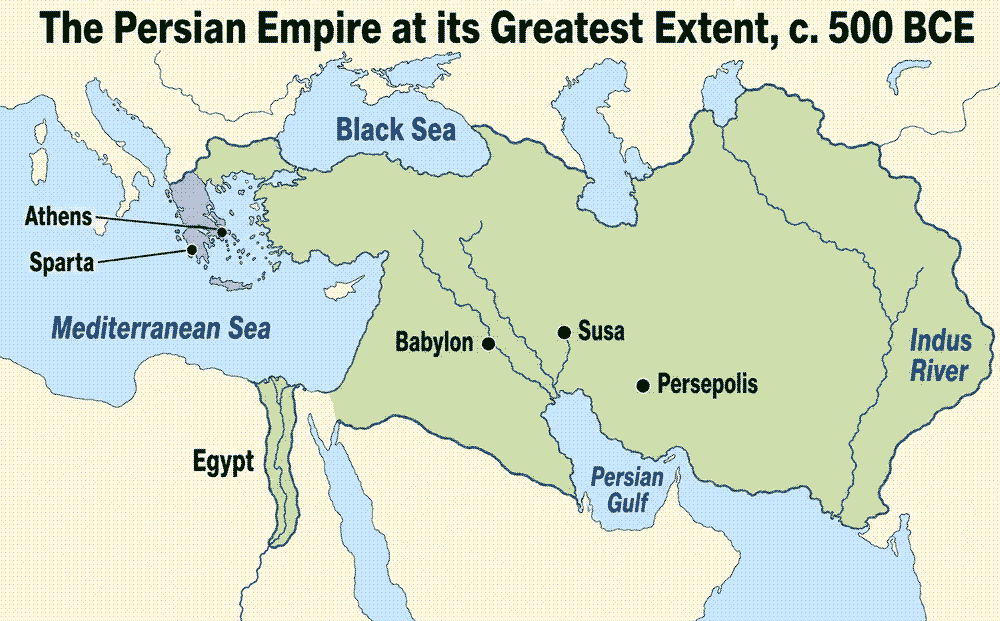
Darius also divided the empire into twenty provinces, each ruled by a governor known as a satrap. A satrap collected taxes, kept order, and answered directly to the king — but day to day, local cultures kept their own laws, religions, and languages intact. Persian rule, layered on top, asked for loyalty and tribute, not conformity. Some estimates suggest that more than 40 percent of the world’s population lived under Persian rule, a larger share of humanity than either the Roman or Mongol empires ever governed.
Xerxes
Darius’ son Xerxes invaded Greece, but a Greek fleet broke his navy at Salamis, and Persia never conquered Greek soil for good. A century and a half later, Alexander the Great burned Persepolis, and ended the empire Cyrus had built.
Resources
Download this lesson as a worksheet with activities
Editable File (Microsoft Word)
Printable PDF (Adobe Acrobat)
Mr. Donn has an excellent website that includes a section on Ancient Greece.