


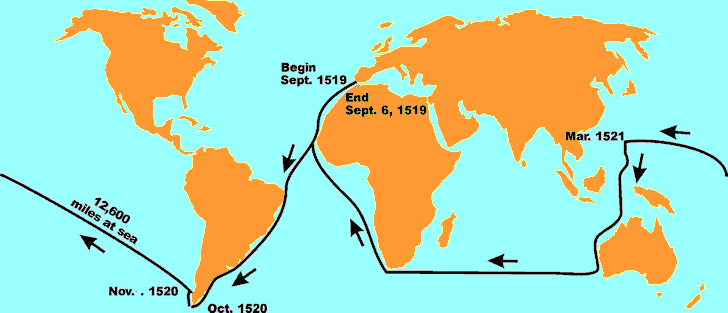
Twenty-five years after Columbus’ first voyage, no ship had ever sailed around the world. Columbus believed he had reached Asia, but he did not realize North and South America stood in the way. Portuguese sailor Ferdinand Magellan set out to reach the East by sailing west.
An Experienced Sailor
But Magellan was a warrior as well as a sailor. He had sailed on many voyages, but he also spent nearly a decade trading and fighting in Asia as Portugal built a trading empire. While in Malacca, in present-day Malaysia, Magellan enslaved a teenaged boy he named Enrique and brought him back to Portugal.
Magellan believed he could find a passage through or around the lands discovered by Columbus that was shorter than the voyage around Africa. Portugal already had a route to Asia and saw little reason to risk money and ships on another, so the king rejected Magellan’s proposal. Bitterly disappointed, Magellan renounced his Portuguese citizenship and offered his services to Spain. Because Portugal controlled the route around Africa, Spain was eager to find a new path to the riches of Asia.
Magellan assembled a crew of 280, but many of the men who signed on to the voyage did not trust him. Some sailors wondered whether a man who had turned his back on Portugal could be trusted to serve Spain. What we now call South America extended much farther south than Magellan had anticipated. The crew had expected to reach Asia quickly, but each week carried them farther from home and no closer to their destination. As supplies dwindled and winter approached, the crew’s distrust of their Portuguese captain deepened. Making matters worse, Magellan kept his charts and plans strictly secret, revealing nothing about the route ahead. Left completely in the dark as supplies dwindled and winter approached, the crew’s distrust of their silent Portuguese captain deepened into terror.
A Doubtful Crew
After fourteen months at sea—far longer than anyone expected—Magellan and his sailors finally found a passage linking the Atlantic and Pacific Oceans in the frigid, stormy waters near the southern tip of South America. The discovery should have marked the end of their troubles. Instead, the crew unknowingly sailed into the largest ocean on Earth and would not see land again for more than three months. Food ran so low that some sailors ate rats and strips of leather cut from their equipment.

Dry Land At Last
After more than three months without seeing land, the starving sailors reached Guam. The brief stop was marked by arguments and petty thefts before the expedition continued west. In the Philippines, Enrique was able to communicate with local people. Magellan and his men realized how close they were to Enrique’s homeland and that he was likely the first person to circumnavigate the earth.
Magellan’s Fatal Mistake
In the Philippines, Magellan shared his Christian faith and helped convert local rulers. When a local chief refused to accept his authority, Magellan led a small force against the warriors of Lapulapu on the island of Mactan. Many islanders believed the battle would reveal whether the Christian God was more powerful than their traditional beliefs. Outnumbered and trapped in shallow water where the cannons on his ships could not help him, Magellan and several of his sailors were killed.
The Ambush
After Magellan was killed, a local ruler invited Magellan’s officers to a banquet, where warriors ambushed the men. With twenty-six more men gone, the crew could no longer man three ships, so they burned one to keep it from being captured and departed for the Spice Islands, where they loaded their two remaining vessels with cloves.
Two Ways Home
The expedition’s leaders chose different routes home. One captain attempted to recross the Pacific, but his ship was later captured by the Portuguese. The Victoria headed west through waters patrolled by Portugal.
Hunger and disease returned as the Victoria crossed thousands of miles of open ocean while intentionally avoiding ports. The crew made a desperate supply stop at a trading post in the Cape Verde Islands, claiming to be a Spanish ship from America that had been blown off course. But when they paid in cloves, it was obvious who they were. The Victoria’s captain lifted the anchor, leaving thirteen men behind to face a Portuguese prison.
More than three years after setting sail, the Victoria sailed into Seville on September 9, 1522. Only eighteen of the men who had begun the voyage remained. They had become the first people to sail around the world.
Resources
Download this lesson as a worksheet with activities
Editable File (Microsoft Word)
Printable PDF (Adobe Acrobat)
Mr. Donn has an excellent website that includes a section on the Renaissance.