


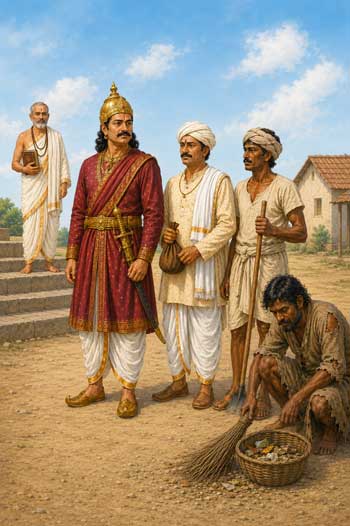
Imagine being told that you can never improve your place in society. It does not matter how hard you work or what you accomplish. Your place was decided when you were born.
Determined by Birth
For thousands of years on the Indian subcontinent, a person’s social class was determined by birth. Historians later called this the caste system. Caste members lived, ate, married, and worked with their own group. A person born into one caste rarely changed castes or mixed with members of other castes. Social rules defined how to behave within a caste and in the presence of people from other castes.
The caste system developed slowly over time from traditions that took shape as Indo-Aryan-speaking people began moving onto the subcontinent around 1500 BCE. Each caste had a clearly defined role. Members of each caste were obligated to look after one another, so each caste had its own support system. These traditions became closely connected with the Hindu religion.

Kshatriya and Brahmin
The Kshatriya (kuh-SHOT-ree-yuh) were the ruling caste. They were warriors, rulers, and government leaders who made many of the everyday decisions in a village. But the Brahmin ranked above them.
The Brahmin were the priests and teachers who possessed knowledge that few other people had. They preserved ancient traditions and understood the calendar. The Brahmin also studied dharma, the laws that governed the universe, giving them the highest authority.
Vaishyas and Sudras
The Vaishyas (VY-shyas) were skilled farmers and merchants. They occasionally had leadership positions in local villages. The Sudras (SHOO-drahs) were laborers and servants. Members of the Sudras caste often worked on the farms of the people of higher castes.
Many Brahmin priests believed contact with lower castes would make them impure. Ancient laws restricted Sudras from hearing the sacred Vedas. One ancient law stated that if a Sudra intentionally listened to the Vedas, molten tin was to be poured into his ears.
Outside the Caste System
Foreigners, people who did not respect dharma, people from isolated tribes, and people suffering from contagious diseases lived outside the caste system. People outside the caste system were sometimes treated as “untouchables” or “outcastes” and were traditionally regarded as unsuitable for personal relations with people who belonged to a caste. Many caste members were vegetarians, meaning that people who ate meat or fish were often not accepted into their society.
Untouchables did work that other castes considered unclean, including disposing of dead cattle, working with animal hides, and working as sweepers and washers. Other jobs brought them into contact with sweat, urine, or feces.
Untouchables were often forbidden to enter temples, schools, and wells where caste members drew water. In some parts of India, even the sight of untouchables was thought to be polluting. Some were forced to work at night so they would not be seen.
From Harijan to Dalit

Mahatma Gandhi referred to the untouchables as Harijans, a term that means “children of God.” Today, many untouchables have rejected Gandhi’s term as demeaning. They prefer to call themselves Dalit, a word that can be translated as “oppressed.”
The Indian government has reserved some government jobs and seats in parliament for Dalits. Despite such measures, Dalits have fewer educational and employment opportunities than Indians from higher castes.
A Changing Caste System
The British gradually gained control of India and ruled most of the subcontinent until 1947. The British often viewed the caste system as rigid and unchanging. We now know that some people and groups were able to rise within the caste system, but this did not happen often.
The caste system became less rigid as the Indian people were exposed to outside ideas. Many Sudras and untouchables were attracted to Islam, which taught that all believers were equal. The Indian Constitution has forbidden discrimination against Dalits since 1950, but discrimination and poverty remain problems. Despite these barriers, India elected a Dalit as president. K. R. Narayanan served in that position from 1997 to 2002.

Resources
Download this lesson as a worksheet with activities
Editable File (Microsoft Word)
Printable PDF (Adobe Acrobat)
Mr. Donn has an excellent website that includes a section on India.